

What developing Wondermade taught me about turning creative possibility into a structured, useful and controllable business workflow.
You have a favourite photograph, an idea for a gift, or a memory you would love to put on the wall. You can picture the feeling. What you cannot necessarily do is write an art brief, choose a print format, work out the crop and confidently send the right file to a printer.
That gap is where this project starts.
Wondermade brings together guided AI creation and the practical steps around turning artwork into a canvas. But the most interesting part of building it has not been getting a model to produce an attractive image. It has been working out everything that must happen around that image before the experience becomes useful.
So, this is not a launch announcement or a guide to finding the application. It is a look behind the build: the product thinking, the Azure building blocks, the awkward lessons and a practical approach you can apply to your own business idea.
The AI output is an ingredient. The business tool is the workflow that makes that output usable, trustworthy and worth paying for.
A quick boundary: this is a development case study. Screenshots are cropped development views using showcase artwork or test data. Controlled payment and supplier testing is not evidence of live sales, completed printing or measured business returns.
The business idea: remove a chain of difficulties
It would have been easy to describe the idea as “an AI image generator with a buy button”. That misses the useful bit.
The person does not really want to become better at prompting. They want to make something meaningful without becoming a designer, a print technician and an order administrator along the way.
That gives the product a clearer job: help someone express an intention, explore a direction, refine the result and make an informed decision about the exact thing they are ordering.
It also gives the business a clearer opportunity. Guided creation could reduce the effort needed to start. A trustworthy proof could reduce avoidable rework. A controlled catalogue could make a personalised service easier to operate. Those are hypotheses to measure, not benefits I am claiming have already materialised.

This is my first suggestion for anyone ideating with AI: find a job where people currently stitch together several tools, decisions and hand-offs. The opportunity may be in joining those steps properly, rather than generating one more piece of content.
Turn the idea into a workflow before adding more AI
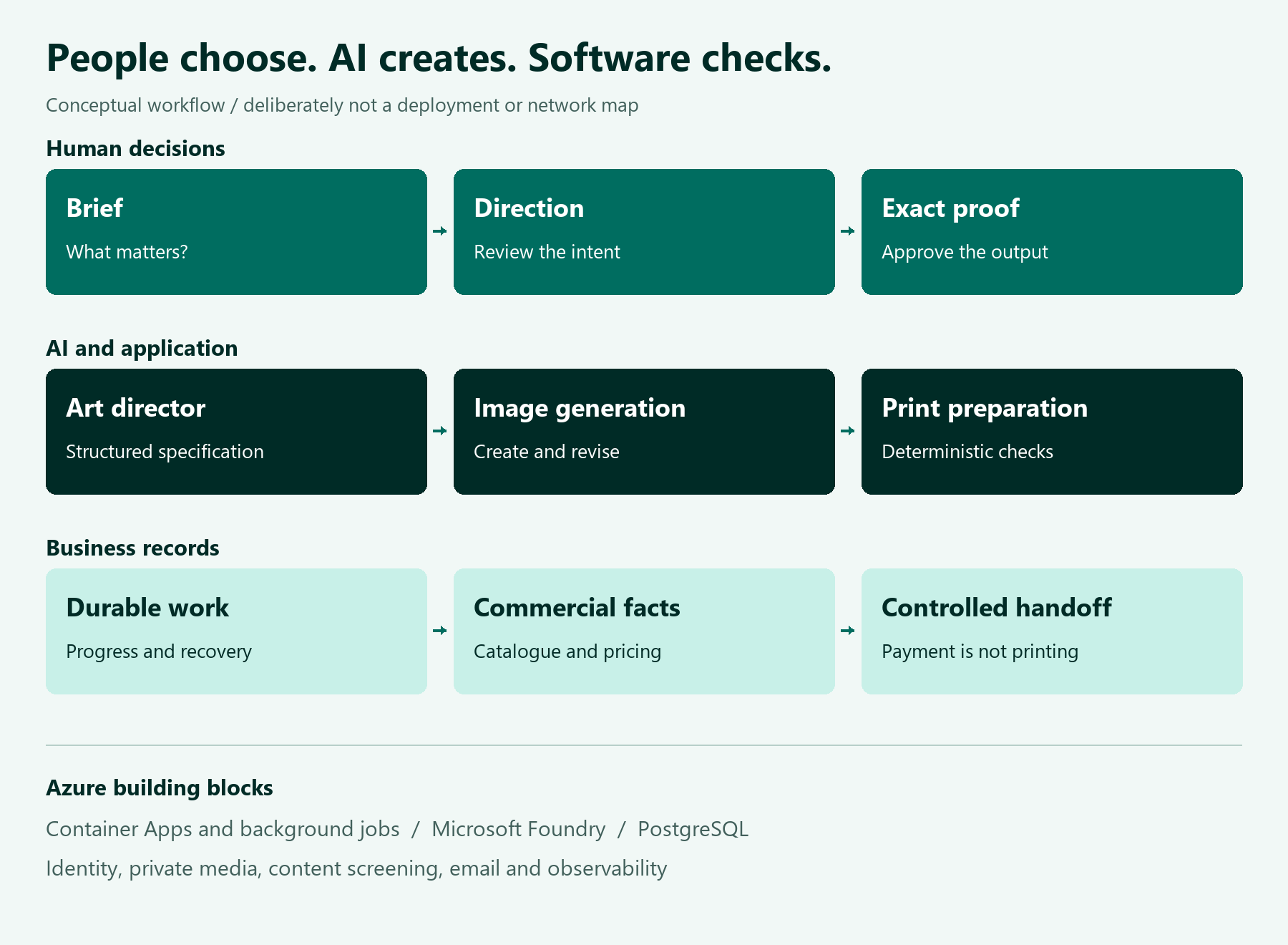
In Wondermade, the useful sequence is straightforward to describe:
- Express the idea. Start with words, reference images or existing artwork.
- Agree the direction. Review the creative brief before generation.
- Create and refine. Keep revisions understandable and preserve the user’s choices.
- Prepare the product. Apply the selected dimensions, layout and finish.
- Approve the exact proof. Make the output being authorised explicit.
- Handle the transaction. Validate delivery, reconcile payment and pass a separate fulfilment gate.
That sequence is more than navigation. Each step needs a defined input, an output, a saved state and a rule for moving on. “An image exists” is not the same as “this print file has been approved”. “Payment confirmed” is not the same as “send it to production”.
The same thinking applies to a proposal builder, a document-processing service or a maintenance assistant. Give the AI a place in a process that somebody understands. Do not make the model invent the process every time.

The model gets a job, not control of the business
I find it helpful to think of the AI as a creative colleague with a defined responsibility.
An art-direction model turns the person’s intention into a structured specification. An image model creates or revises the artwork. Deterministic software prepares the print file and checks the technical requirements. The customer makes the approval decision.
That separation matters. A model might be very good at suggesting a composition. It should not also be the authority on whether a payment arrived, whether a delivery service is available or what the final price should be.
The art-direction response is therefore not just a paragraph we hope the next component understands. It has a defined shape, with fields for the image prompt, output settings and relevant notes. The application validates it and retains control of the technical settings.
Microsoft documents structured outputs with JSON Schema for supported models and APIs. That helps software consume a response reliably. It does not prove that the response is correct, appropriate or useful. Application validation and human judgement still have work to do.

Where Azure fits: give every service a business job
Azure is not the business idea. It provides the building blocks for running that idea with durable records, controlled access and operational visibility.
At a deliberately high level, the implementation brings together a web application, background processing, a relational system of record, AI services and controlled integrations. Here is the useful translation from technology to purpose:
| Building block | What it does for the product |
|---|---|
| Azure Container Apps and background jobs | Run the customer experience and work that should not depend on an open browser request. |
| Microsoft Foundry | Support the art-direction and image-generation roles behind the guided experience. |
| Azure Database for PostgreSQL | Keep creative work, approvals and commercial records durable and connected. |
| Identity and controlled media access | Keep personal artwork associated with its owner instead of treating every image as a public asset. |
| Content screening, email and observability | Support safer inputs, recoverable communications and diagnosis when work does not complete as expected. |
There is an important implementation detail here: the durable queues in this build are application-managed, database-backed work records. I am not describing a Service Bus or Durable Functions implementation. Azure supports several patterns; the point is to choose one deliberately and understand its behaviour.
Container Apps jobs provide a useful distinction between continuously running applications and finite background tasks. Managed identities can reduce application-managed credentials when accessing supported Azure services; they do not make third-party credentials disappear.
The challenges that made the product better
A beautiful image is not a print-ready file
This is where the creative experience meets some very practical engineering. A preview can look lovely whilst hiding a crop, an aspect-ratio mismatch or a problem with the final dimensions.
The response was to make print preparation and approval first-class steps. The selected product determines the required file. Placement preserves the source’s proportions. The prepared output is saved, and approval belongs to that output rather than a vaguely similar preview.
Before handoff, the system checks the approved file and the supplier’s current requirements again. If an assumption has changed, the right outcome is review, not quietly sending something different.
There is no magic in enlarging pixels, either. Resampling can produce required dimensions; it cannot recover detail that was never there or guarantee the sharpness of a physical print. That limitation belongs in the experience, not hidden in the small print.

The wider lesson: approval must attach to the exact thing that will be used. That is just as relevant to a generated proposal, an invoice or a report as it is to a canvas.
Long-running AI work needs more than a spinner
Generation, revisions and supplier synchronisation do not always finish neatly within one request. Providers can be slow. Work can fail part-way through. A user can leave the page.
The implementation uses durable work records, saved progress, bounded retries and recovery. A worker temporarily claims a job, and the system can recognise work that needs attention rather than relying on a browser tab to keep it alive.
The business benefit is not simply “more reliable AI”. It is the ability to tell someone whether their work is queued, progressing, retrying or failed, and to recover without blindly starting again.
Retries still need care: retrying a generation may incur another charge. A retry policy is not an exactly-once billing guarantee. Record the attempt and make the failure explainable.
The catalogue became a data problem
A product is not just a name and a price. It can have variants, finishes, print requirements, delivery methods and supplier quotes that change over time.
Development exposed the need to distinguish one product from its options, recognise duplicate identities and keep shipping evidence attached to the correct option. A missing quote must never quietly become “free delivery”.
We introduced clearer product identity, exact-option evidence and freshness checks, alongside controls over what can be published. During consolidation, conflicting listings caused a migration to stop rather than silently choose a price. The resolution was deliberate: reconcile the conflicting listings whilst preserving historical records.
That is not the glamorous part of an AI build. But it is absolutely the difference between an impressive demonstration and a business tool you can reason about.

A successful payment must not become an accidental print order
Payments and fulfilment are separate state changes, with different consequences. The system verifies payment events, avoids recording the same event as a new purchase twice, and keeps the order’s agreed facts intact.
Supplier handoff then has its own checks and controls. In development, a controlled diagnostic reached a held sandbox order. That established something useful about the integration without producing or shipping anything.
It did not reproduce the original rejected-order scenario, so it would be wrong to claim that one successful diagnostic proved the original problem resolved. Keeping that distinction clear is part of honest engineering.
Prodigi’s documentation distinguishes sandbox testing from live fulfilment. A hosted application, a successful test payment and a commercially commissioned service are three different milestones.
Privacy and safety have to survive the whole journey
Personal images cannot become an afterthought once a generation succeeds. Ownership checks and controlled access need to cover uploads, revisions, previews and the assets used later in the order flow.
The build includes source-image screening and account-scoped media access. More broadly, Azure AI Content Safety can support analysis of harmful-content categories, and Azure publishes storage security recommendations for protecting data.
None of that is a blanket guarantee about copyright, consent or appropriateness. People still need rights to the material they use. Platform safeguards remain in place; the answer to a difficult creative request is a safer brief or a stopped workflow, not bypassing those safeguards.
The same care applies to sharing the development story. These illustrations exclude private photographs, account details, application addresses and deployment identifiers.
Design the operator experience, not just the happy path
A business tool has at least two audiences: the person using the service and the person responsible for it.
For the customer, the approval screen needed a clearer sequence, more useful product detail and a visible confirmation of what had been approved. For the operator, catalogue controls needed to distinguish discovery, validation and publication rather than making them look like one action.
That is why interface work belongs beside backend work. If an operator cannot tell whether an action failed, or a customer cannot tell which file they approved, the application has not communicated its state well enough.
Durable email handling is another example. Recording the intention to send a message allows failed attempts to be recovered. Azure Communication Services Email supports transactional application email, but provider acceptance still does not prove someone received or read it.
Cost the outcome, not the impressive generation
A single generation price is not the cost of running an AI-enabled service. You also have revisions, abandoned sessions, finishing work, storage, compute, communications, payment fees and support.
For a useful starting point, calculate:
AI cost per paid order = total AI spend across all sessions in the period ÷ paid orders in the same period
Count the non-buyers as well as the buyers. If a hypothetical service spends £80 on AI across a period and receives 25 orders, that is £3.20 per order before other costs. These are invented numbers to illustrate the arithmetic, not Wondermade costs or vendor prices. With no paid orders, the metric is undefined; report the spend rather than inventing a unit cost.
Next, calculate contribution after supplier and delivery costs, payment fees, allocated AI spend and other variable costs. Then account for fixed overheads, tax treatment, refunds and support before talking about business profit.
Cost note, 6 September 2026: the illustration is in GBP. No model-specific retail rate is asserted or included in a platform-price total; an independently verified rate for this build’s exact model configuration is unavailable here. Check current public rates for the chosen model, deployment type and region. Prices and currency conversion change.
A blueprint you can use for your own idea
You do not need to build a canvas application to use these lessons. Start with a repeatable business task and work through five questions.
- What outcome is somebody trying to achieve? Write it without naming a model. For example: “Create a review-ready proposal from an agreed brief.”
- Where does AI genuinely help? Use it for interpretation, drafting or creative variation. Keep prices, permissions, calculations and transaction state under explicit software rules.
- What has to be true before the next step? Define a small contract: required inputs, output format, validation, approval owner and recovery behaviour.
- What happens when it fails? Walk through invalid output, an interrupted job, a repeated event and a changed requirement. A useful pilot exercises the unhappy paths.
- How will you demonstrate value? Establish the current time, error rate or cost first. Compare the pilot against that baseline whilst tracking quality and risk.
For evaluation, keep a small, consented set of representative tasks and expected outcomes. Look at whether the brief preserved the user’s intent, whether the output needed rework, whether approval stayed valid and whether failed work recovered safely. Extend that set when a real failure teaches you something new.

For a proposal service, your approval gate may be a subject-matter expert. For document processing, it may be a reviewer confirming extracted fields. For an operations assistant, it may be an engineer authorising an action. The shape changes; the principle travels.
Build the useful thing around the clever thing
What I love about this kind of development is that it makes the opportunity tangible. You can start with a very human need and use Azure and AI to build something people can understand, inspect and improve.
But the lasting lesson from Wondermade is not “look what an image model can do”. It is that the work around the model matters: the guided brief, the durable record, the honest preview, the approval, the recovery path and the commercial boundaries.
That is where an interesting experiment begins to take the shape of a business tool.
Pick one awkward hand-off in your own organisation. Sketch the outcome, the decisions and the checks. Then ask where AI can help. You might find that the most valuable idea is not a brand-new capability, but a much better journey through work people already need to do.
I’d love to hear which workflow you would tackle first.
Until next time, stay curious and keep building. Cheers!
Further reading
First-party documentation consulted on 6 September 2026. These sources explain platform capabilities; they are not certification of this application.
- Microsoft Learn: Azure Container Apps jobs
- Microsoft Learn: Structured outputs
- Microsoft Learn: Managed identities
- Microsoft Learn: Azure AI Content Safety
- Microsoft Learn: Blob Storage security recommendations
- Microsoft Learn: Communication Services Email
- Prodigi: Print API reference and sandbox behaviour